My sister’s funeral was yesterday. I have thought about little else. I have been thinking about her; her personal narrative in the grand scheme of things. And, let’s just say that I have a LOT to say.
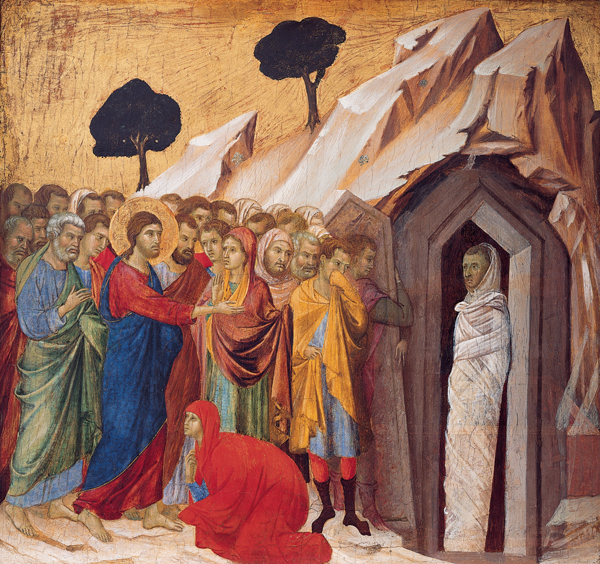
But right now my grief takes me to scripture. Specifically, it takes me to the story of the “Raising of Lazarus” that is only found in the Gospel of John. I like this narrative for many reasons, but probably not the reasons that you are thinking. I like the human-ness of the people in the story. The apostles traveling with Jesus who didn’t understand the use of metaphor, (like many of my students) and Martha, the realist with faith, who is not afraid to speak her mind. All of the characters in the story are Jewish, including Jesus, which is probably a good thing to remember as we read the story.
Here is the story from the New American Revised Edition (the official version of the bible for the Catholic Church in the United States) John 11:
“Now a man was ill, Lazarus from Bethany, the village of Mary and her sister Martha. Mary was the one who had anointed the Lord with perfumed oil and dried his feet with her hair; it was her brother Lazarus who was ill. So the sisters sent word to him, saying, “Master, the one you love is ill.” When Jesus heard this he said, “This illness is not to end in death, but is for the glory of God, that the Son of God may be glorified through it.” Now Jesus loved Martha and her sister and Lazarus. So when he heard that he was ill, he remained for two days in the place where he was. Then after this he said to his disciples, “Let us go back to Judea.” The disciples said to him, “Rabbi, the Jews were just trying to stone you, and you want to go back there?” Jesus answered, “Are there not twelve hours in a day? If one walks during the day, he does not stumble, because he sees the light of this world. But if one walks at night, he stumbles, because the light is not in him.”He said this, and then told them, “Our friend Lazarus is asleep, but I am going to awaken him.” So the disciples said to him, “Master, if he is asleep, he will be saved.” But Jesus was talking about his death, while they thought that he meant ordinary sleep. So then Jesus said to them clearly, “Lazarus has died. And I am glad for you that I was not there, that you may believe. Let us go to him.” So Thomas, called Didymus, said to his fellow disciples, “Let us also go to die with him.”
When Jesus arrived, he found that Lazarus had already been in the tomb for four days. Now Bethany was near Jerusalem, only about two miles away. And many of the Jews had come to Martha and Mary to comfort them about their brother. When Martha heard that Jesus was coming, she went to meet him; but Mary sat at home. Martha said to Jesus, “Lord, if you had been here, my brother would not have died. [But] even now I know that whatever you ask of God, God will give you.” Jesus said to her, “Your brother will rise.” Martha said to him, “I know he will rise, in the resurrection on the last day.”Jesus told her, “I am the resurrection and the life; whoever believes in me, even if he dies, will live, and everyone who lives and believes in me will never die. Do you believe this?” She said to him, “Yes, Lord. I have come to believe that you are the Messiah, the Son of God, the one who is coming into the world.”” –John 11: 1 – 27
Martha asks what anyone would ask, “Where were you?” “Why weren’t you here? Why didn’t you help him?” I have the same questions regarding the death on my sister.
Grief is a thing that becomes a part of us. I think it becomes a part of us because we are connected to the person we lost out of love. It isn’t a mistake that of all 613 commandments, (yes, there are 613, not 10) Jesus picks Deuteronomy 6:4 and Leviticus 19:18 when picking the two most important commandments. (See MK 12: 28 -34) DT 6:4 is the beginning of the most important prayer in Judaism, the Shema. “Hear (Listen) O Israel, You shall love the Lord your God with all your heart, all your soul, all your strength…” It is a prayer said several times a day, so that we never forget. “Speak these words when you are at home or away, when you lie down and when you get up…”
We go to sleep with words of love on our lips, and we awake with words of love.
For messianic (apocalyptic Jews like the author of the Gospel of John, and the characters of Martha and Mary) and Christians, sleep is a preferred metaphor for death because it anticipates the apocalyptic promise of the resurrection. Not in abstract terms, but in quite literal ones. And that is how Martha responds to Jesus, “ I know he will rise, at the resurrection on the last day.” But that doesn’t help her grief at the moment. She is still left with the question, “Where were you?!”
Here is a homily that Dr. Amy-Jill Levine, PhD gave during Holy Week when this particular passage from the Gospel of John was the reading. She is an Orthodox Jew (and one of my favorite scripture scholars ever) and is a New Testament Scholar who teaches at Vanderbilt. She delivered this with her particular style of chutzpah and humor – and hit close to home.
Understanding the Shema (Sh’ma) as embodying love, the addition to the Shema said in the evening incorporates the Ahavat Olam which emphasizes that “when we lie down” we “lie down” with love on our lips and hearts, and so “when we rise up forever” we rise with that love.
Hit play, close your eyes, and just listen to the Ahavat Olam from the Evening Sh’ma. Hear the hope in the melody. Part of the prayer has been translated into English – you’ll recognize it.
For those of you who don’t know, the term Mitzvot (plural of mitzvah) means blessings. Yes, it can be translated, “commandments,” but it gives the whole thing a different feel – these are not seen as commands from an unfeeling god, but blessings given to us out of love.
From the rising of the sun to its setting, may the blessings, the Mitzvot, of God be ever on our lips.
 acorns2oaktrees