I no longer watch the news. I mean, I listen to NPR like a motor car with too little fuel, in fits and starts, seeking something that isn’t there, but trying nonetheless. I have been driven away by the chaos of the world into a type of seclusion, which the present quarantine situation is, perhaps, a viable metaphor in lived space. It is as if we were reliving the Enuma Elish, and many of us have retreated, like the gods themselves, from the destructive chaotic din of Tiamat and her armies, waiting without hope, for as TS Eliot might say, “hope would be hope for the wrong thing.” [i]
“Our only health is the disease
If we obey the dying nurse
Whose constant care is not to please
But to remind us of our, and Adam’s curse
And that, to be restored, or sickness must grow worse.”[ii]
No one needs reminding of the current chaos of Covid-19. But, over the past several years, the rash and rush of hatred, ignorance and anger have become so commonplace as to feel as it should be the norm. We know that it is not the norm. Every fiber of our being knows that it is not right. The incessant inundation of banality is replacing our intuitive expectation of truth as a rubric with which to gauge our experience. As Chapman predicted in Hero and Leander, we are seeing “Barbarism and Avarice. . .eating earth and excrement and human limbs,[making] proud ascent to seats of gods. . .” [iii]
“And so each venture
Is a new beginning, a raid on the inarticulate
With shabby equipment always deteriorating
In the general mess of imprecision of feeling,
Undisciplined squads of emotion. . .”[iv]
So, I retreat. Not ignore, mind you, but retreat “at the still point of the turning world”[v] or, at least I try. “These are only hints followed by guesses; and the rest is prayer, observance, discipline, thought and action;”[vi] things that the swirling savagery that surrounds us lack.
I escape for a little while to the side of Athene, who has sustained the horror of chaos with steadying Wisdom.
“[H]er unthinkable beauty was neither that of age nor of youth. That her eyes were the only things you thought of looking at, and that to be her was terrible, whereas to be with her was the only joy. If you can understand this, she was herself so unhappy that words only melt in such temperatures, but towards other people she was the spirit of invincible mercy and protection. She lived, of course, beyond sorrow and solitude, and, if you follow me, the suffering which had brought her there had left her with a kind of supernatural good manners.”[vii]
I sit in the stillness and I meditate and read and teach.
As Joseph Campbell said, “We cannot cure the world of sorrows, but we can choose to live in joy. When we talk about settling the world’s problems, we’re barking up the wrong tree. The world is perfect. It’s a mess. It has always been a mess. We are not going to change it. Our job is to straighten out our own lives.”[viii]
And, so that is what I try to do.
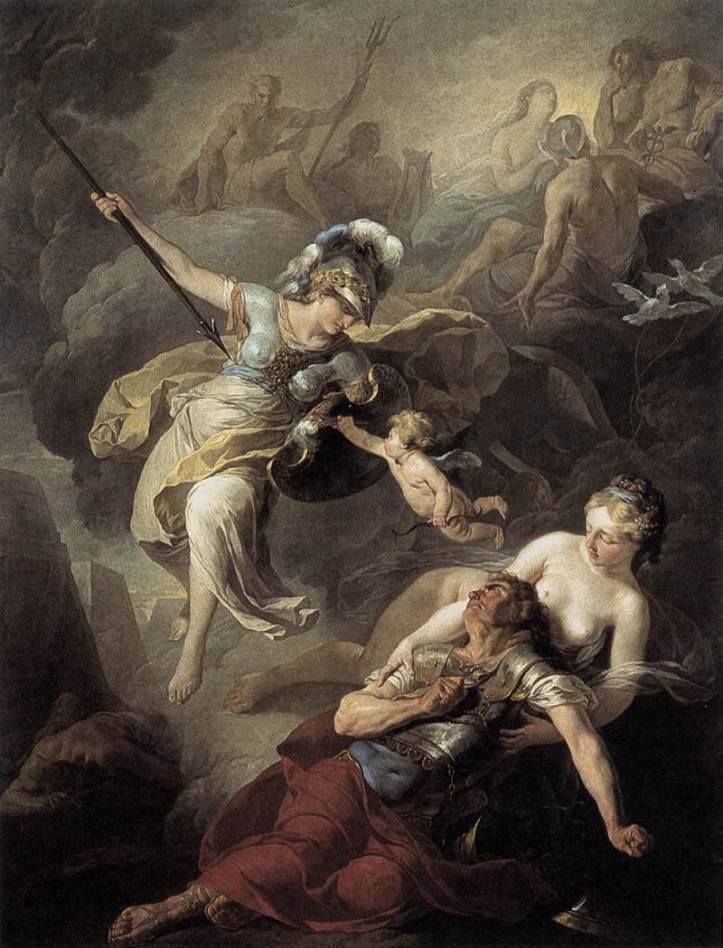 The Combat Of Mars And Minerva, Joseph-benoit Suvee
We have the comfort, perhaps, of knowing that Reason and Wisdom overcomes the arrogance of War.
[i] T.S. Eliot, Four Quartets, East Coker, III
[ii] ibid
[iii] Chapman, Hero and Lander, III, 131
[iv] T.S. Eliot, Four Quartets, East Coker, V
[v] T.S. Eliot, Four Quartets, Burnt Norton, II
[vi] T.S. Eliot, Four Quartets, The Dry Salvages, V
[vii] T.H. White, The Sword in the Stone (stand alone volume), chapter 18
[viii] – Joseph Campbell in a Joseph Campbell Companion: Reflections on the Art of Living
 acorns2oaktrees