I was at a seminar, not too long ago, that focused on memory: personal memory and social memory, and its relationship to how we understand ourselves (again, both personally and socially.) It was a fascinating and eye-opening seminar.
One of the studies cited during the seminar, was a study published in Psychomonic Bulletin and Review (2006, 13 (5)) by John G. Seamon, Morgan M. Philbin, and Liza G. Harrison from Wesleyan University, in Middletown Connecticut, titled (quite memorably), “Do you remember proposing marriage to the Pepsi machine? False recollections from a campus walk.” It really is a fascinating study, well worth reading. The conclusion of the study (to get right to it) was that we are not only capable of, but we actually create false memories for ourselves and convince ourselves of their actuality. Students were taken to specific predetermined locations and asked to do something mundane or something bizarre. For example, one student was taken into a library and made to stand in front of the stacks facing a dictionary. Then she was told to look up a certain word. A second person was then taken to that same spot, and also told to look up the word – but this time, notably, without the dictionary. In other words, they were asked to imagine looking up the word.
The result was that, more often than not, (ibid.) the person who imagined looking up the word was just as convinced as his counterpart (who actually did it) that he had done it in reality.
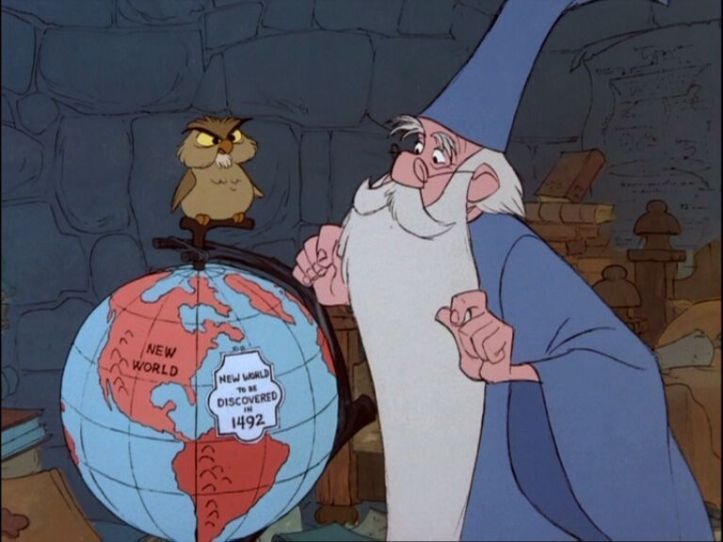
The teacher who I was thinking about was Merlyn in TH White’s, Once and Future King. I don’t think that any fictional (?) teacher was more influential on me. And yet, I am constantly amazed at how little I learned. Or, put more positively: I am constantly amazed at how much I continue to learn. Little moments of epiphanal flashes in which one neuron suddenly connects with another – as if the neuron, itself, was waiting for the right trigger.
– Thinking about teachers whom I learned from prompted me to think about TH White’s Merlyn.
What if I can get my students to imagine in class as a part of a lesson? How would that impact their memory, learning, and understanding?
I think that imagination is the most culturally undervalued human ability. But, gentle reader, that will have to be the subject of another post.
 acorns2oaktrees